


Hantavirus

2026 Hantavirus Outbreak
The cruise ship MV Hondius was the site of a severe outbreak of hantavirus in May 2026. At least three people have died and others are confirmed to have the virus. The ship docked on May 10 for passenger disembarkation and medical care, with individuals being flown to their home countries for monitoring and treatment.
As a public service, we’re making the chapter focused on Hantaviral Diseases within our Control of Communicable Diseases Manual freely available as we confront the outbreak on the MV Hondius.
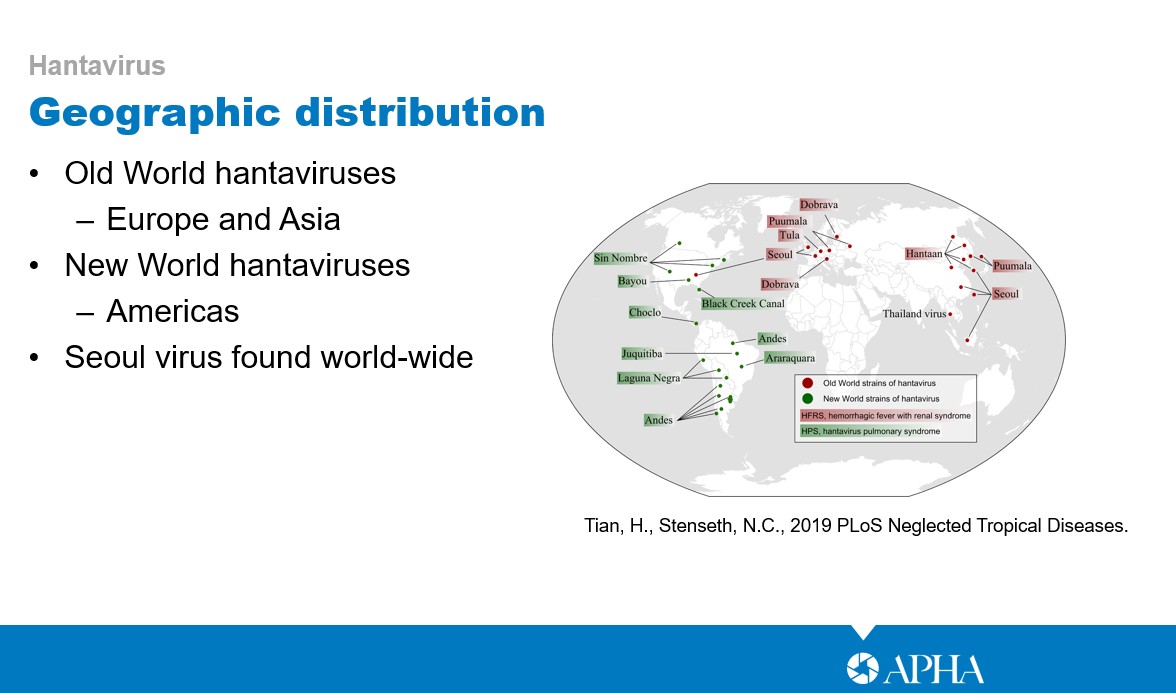
Hantaviruses are a family of rodent-borne viruses that can cause severe lung and heart disease. The Sin Nombre virus was first identified in the US in 1993 during the 4-corners outbreak, followed by numerous other new world hantaviruses across the Americas. From 1993 to 2022, 864 cases have been reported in the US.
Although most states have registered cases of hantavirus, 94% of cases have occurred west of the Mississippi. Infection was fatal in 35% of cases during this time period.
Hantavirus outbreak FAQs
Q: How does this outbreak compare to COVID-19, and why are experts so certain this will not be a new pandemic?
A: The risk of human-to-human transmission for Hantaviral diseases is extremely rare, and limited to Andes virus infections. Diseases that can spread easily in the extremely close environment of a cruise ship are unlikely to spread the same way in other settings.
Q: How does this outbreak compare to recent measles outbreaks, and why is it less of a concern? How easy is it for hantavirus to spread?
A: Measles is one of the most contagious diseases on the planet, and even short periods of limited contact with an infected person can be sufficient to spread the disease. An infected person breathing for a short time in a room can be enough to infect an unvaccinated person who enters that room even hours later. Transmission of hantavirus, however, requires exposure to aerosolized rodent excreta, a vector that is mediated by region and sanitation, and most infected patients will not pass the disease to another person.
Q: In what settings do outbreaks typically occur?
A: Hantavirus is largely associated with certain regions and professions. Per the section on risk groups in our chapter on hantavirus, "The main human groups at risk are persons in rural populations who come into contact with rodents as part of their occupation (forestry workers, farmers, military deployed in the field). Outdoor enthusiasts have been found to have elevated risk of hantavirus exposure." Preliminary reports of the current outbreak indicate that the initial infections may have taken place during a birdwatching event at a landfill, which is the type of environment where exposure to disease vectors was much higher than usual. It would be unusual for most people to encounter such a setting.
Download Interactive Slideshow on Hantavirus
Created by Catherine L. Troisi, PhD, Professor, UTHealth Houston and Co-Editor, Control of Communicable Diseases Manual.
In The News
On May 11, Nebraska medical officials held a briefing after Americans from the hantavirus-hit cruise ship arrive in Omaha. Watch as Nebraska medical officials hold a briefing about the hantavirus outbreak on the cruise ship MV Hondius and the U.S. passengers who were evacuated.
CGTN’s Asieh Namdar speaks to Dr. Georges Benjamin, an internal medicine specialist and the CEO of the American Public Health Association. They discuss the outbreak of Hantavirus that has claimed three lives and infected dozens aboard an Atlantic cruise ship.
WHO Resources
WHO
CDC
- Andes Virus Outbreak on a Cruise Ship: Frequently Asked Questions
- CDC Provides Update on Hantavirus Outbreak Linked to M/V Hondius Cruise Ship
- 2026 Multi-country Hantavirus Cluster Linked to Cruise Ship
APHL