




Public Health Newswire from The Nation’s Health brings you the news you need now


Public Health Newswire
Posters: AI for vaccine education, homelessness research, diabetes care
- Melanie Padgett Powers
As you walk into the Public Health Expo at APHA 2026, there’s an exciting vibe, a positive energy level. Everywhere you look, people are engaged in conversations, asking questions, sharing ideas. The breadth of public health is wide — covering everything from antimicrobial resistance to rural health, from intimate partner violence to public health workforce recruitment — but the public health community comes together with a collective voice to advocate for “optimal, equitable health and well-being for all,” as APHA’s vision states.
That diversity of topics — but offered through a shared vision — is front and center at the poster sessions held at various times Sunday through Tuesday.
Here are just three posters we learned about this week:
AI chatbot to improve measles vaccination rates
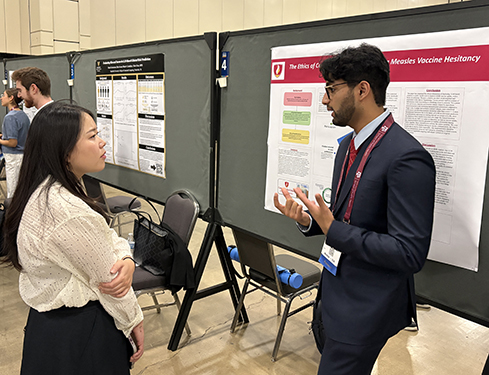 Arnav Goel, a fourth-year medical student at Cooper Medical School of Rowan University in Camden, New Jersey, combined two trending health topics for his poster: measles and artificial intelligence.
Pennsylvania is experiencing a record-breaking measles outbreak, with more than 1,400 cases and five deaths, which got Goel thinking about how to improve vaccination rates. At the same time, he couldn’t help but notice how much AI is being implemented into healthcare, including into electronic medical records. He wondered if an AI chatbot could be used to “nudge” parents into vaccinating their children through educating and dispelling misinformation.
His poster outlined a conceptual framework of his idea. “AI is an incredibly persuasive tool. A lot of recent studies argue that AI is better at persuading than actual people or actual people-made pamphlets, which is a bit mind-boggling to think about,” Goel said.
He wondered: Could an AI chatbot be used in an ethical fashion? What are some of those ethical considerations? “Specifically, what I was intrigued by was the idea of nudging, the idea of creating an environment to influence a choice.”
However, a program that would use AI in this way must not tip the balance into “hyper-nudging,” he said. “There’s this risk that you start subverting autonomy.”
His framework points out that the AI tool should not store data for the purpose of training the program. Instead, people should analyze the data to ensure AI is working as intended and not crossing any ethical boundaries.
He noted that AI tools are still in their infancy, but they’re also not fading away. “Whether we like it or not, these tools are so prevalent, and I think it’s better to be at the table and to be influenced in regulating, rather than ignoring. AI has the potential to do a lot of good for these parents or their children.”
Measuring sleep disruption, alcohol use among unhoused population
Since Shannon Smith starting working with her PhD adviser at UNT Health Fort Worth, she has become more involved in helping improve healthcare for unhoused people. Her research interests include substance use and sleep, so she decided to combine all three of these areas for her latest research.
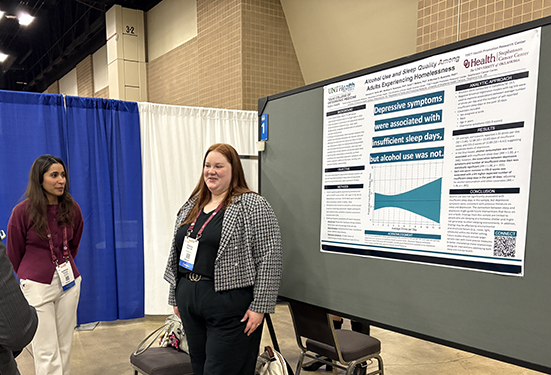 Smith pointed out that 771,000 people in the U.S. experienced homelessness on a single night in 2024. Sleep disruption is common. Research in the general population shows that alcohol use and sleep disruption are related, so Smith set out to find if this was true among unhoused people also.
“We know that in the general population, alcohol use and sleep have a bidirectional relationship — alcohol use impacts your sleep quality and your hours of sleep and your REM stages and all of that. But then we also know that poor sleep can lead to greater cravings the next day for alcohol, so we know it’s a big reciprocal cycle.”
Clarifying the relationship is important, she said, because both alcohol use and disrupted sleep can exacerbate psychiatric symptoms and inhibit a person’s ability to find work and housing and to maintain healthy relationships.
Smith recruited English-speaking adults from a homeless shelter in Dallas, asking them to complete a self-reported survey about their alcohol use, sleep disruption and depressive symptoms over the past 30 days.
Her survey data did not show a clear connection between sleep and alcohol use in this population, but Smith said that could be because the data was self-reported over the past 30 days — information that could be challenging to remember. The survey participants were also people who stayed in a shelter, where alcohol is forbidden, so that could have affected the results as well, she said.
Next, Smith would like to dive into the daily-level data of who reported poor sleep and the number of drinks they reported the next day. “So that is my next step. I just have to learn those statistical methods first. … I mean, we know that there are people who will literally wake up at 7 a.m. and the first thing that they do is go and buy a drink, and then they’re tired during the day. And so I think it’s kind of important to understand this a little bit more.”
Going from the classroom to the field was eye-opening, she said. “I’m a very empathetic person, but being boots on the ground, recruiting weekly, running appointments, hearing people’s stories — it warms my heart knowing that the work that we’re doing is potentially having an impact.”
Uncontrolled type II diabetes linked to food insecurity
Type II diabetes is one of the top five causes of death and hospitalization in Montgomery County, Maryland, a suburb of Washington, D.C. In an effort to reduce the disease burden, the county’s Department of Health and Human Services conducted a case-control analysis of emergency room visits to gather data to inform the county council, which allocates funding and resources.
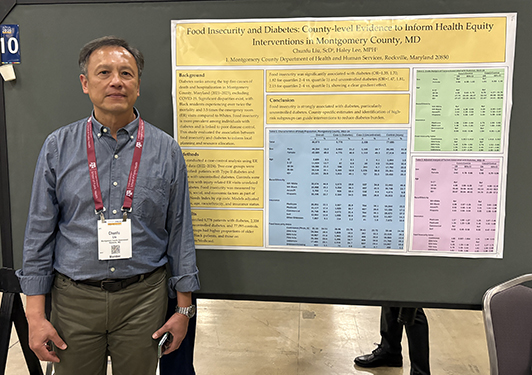 “Diabetes take a lot of healthcare resources, especially for the diabetes patients with uncontrolled management,” said poster presenter Chunfu Liu, chief epidemiologist for the county’s health department.
Researchers identified two groups: patients with type II diabetes (9,778 patients) and those with uncontrolled type II diabetes (2,338). The control group were patients with injury-related ER visits unrelated to diabetes (77,095 patients). The case groups had higher proportions of older adults, Black patients and those on Medicare/Medicaid. Food insecurity was measured through health, social and economic factors by zip code.
“Through this project, we found out that food insecurity is highly associated with diabetes, with an even higher association with uncontrolled diabetes. There is a clear gradient effect,” Liu said.
The findings were not surprising to Liu’s department — but now they have data they can show the county council to illustrate that addressing food insecurity can help people better manage their diabetes and potentially reduce ER visits, thus lowering healthcare costs.
“In the past when we talked about ‘this is what the literature shows,’ we had no idea whether that association was also valid in Montgomery County,” he said. “But through this project, because we used county-level data and also found the association — and identified the population subgroup that we can target for intervention — that will be very helpful to us.”
Photos: Se Eun Kim and Arnav Goel; Shannon Smith; Chunfu Liu. Photos by Melanie Padgett Powers.