





Public Health Newswire from The Nation’s Health brings you the news you need now


Building public trust through interaction with scientists, health workers
- Yanit Asamnew
As trust in science falls in the U.S., Emma Courtney, a PhD student at Cold Spring Harbor Laboratory, is doing her part to help reverse that course. Last year, she co-founded Science for Good, a nonprofit organization that encourages scientists to become involved in their communities.
The Nation’s Health spoke to Courtney about her work, how scientists need to engage with their neighbors and why she and her peers have hope, despite federal actions that undermine science. Courtney will be speaking at APHA’s Policy Action Institute June 9-11.
Tell me about Science for Good, which you co-founded in March 2025. What are the goals?
Our overarching goal is to empower scientists to engage meaningfully with their communities, whether that’s through direct engagement or by helping scientists become agents of change in other ways, like supporting local community initiatives.
A lot of that comes from the fact that scientists usually aren’t really incentivized to do work outside of their research. There’s not a lot of rewards for science communication or community engagement. At the same time, I see so many of my peers who genuinely want to make a difference in their communities, both through their work and more broadly, but don’t really know how to get started.
What skills do you hope to build among scientists through your work?
I always want to emphasize that we have something to learn from everyone we meet, whether it’s another scientist, someone whose experiences are different from ours, or even someone who holds anti-science views. There are often reasons people hold those beliefs, and sometimes a lot of the problems simply come down to unfamiliarity or lack of exposure.
The skill I really hope we help create is the ability for people to go into conversations with more open-mindedness and respect, and to build trust in a way that allows for real relationships and genuine dialogue. I don’t think scientists should approach communities as if they’re just beacons of knowledge that can come in and fix everything. I think that’s often where science falls short — when it isn’t responsive or when it doesn’t listen to what people are going through and try to respond in a meaningful way. 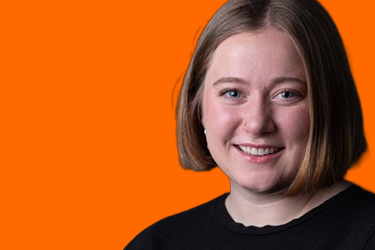
What are some of the issues Science for Good has taken a stance on?
A lot of our work has actually been intentionally nonpartisan, because we do want to reach people who might be put off by more overt political messaging. At the same time, many of the positions we’ve taken center around the importance of federal funding for science, the importance of DEI pathways and diversity mechanisms in grants. And ensuring that the scientific workforce fully represents the population of the U.S., as well as the global population more broadly.
We also care deeply about making sure there isn’t political interference in science in the ways we’ve recently seen. That includes ensuring researchers continue to have access to public health data that allows them to track important outcomes over time, as well as climate data and global weather monitoring systems that are essential for scientific research and public understanding.
Misinformation about public health has become widespread. How does your work address that?
What I’ve realized is that there are some people whose minds probably won’t change, and there are also people who already trust science. But there’s a really large group in the middle who don’t necessarily know what to think. They may not have strong beliefs either way, or they may not even be aware of things like cuts to science funding or broader challenges facing public health and research. They’re seeing information from different sides and trying to figure out who to trust.
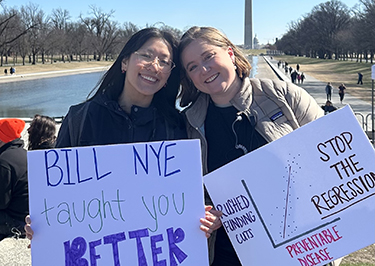 A lot of our work is based on the idea that trust is built through relationships. We hope that by encouraging scientists to be more publicly engaged and more connected to their communities, people can start to see scientists not just as distant experts, but as real people who care about their communities and are genuinely trying to help.
You are an engaged young professional and health advocate, so tell me what is needed to improve and support U.S. public health in years to come?
There are a lot of reasons for hope, especially seeing so many young people who are engaged, motivated and ready to take on leadership roles in public health. What’s really needed going forward is stronger trust-building between scientists and the public, not just sharing information but actually listening to communities and responding to what they need. That kind of relationship is key.
You will be part of APHA's Policy Action Institute which will be held online and in Arlington, Va. Why should people attend?
It’s a special event that’s trying to bring together people who are interested in public health, to build great relationships and take what they’ve learned with them into their future advocacy work.
This interview was edited for space, length and clarity.
Top: Photo illustration by Michele Late. Bottom: Courtesy Emma Courtney