






Public Health Newswire from The Nation’s Health brings you the news you need now


2025 Annual Meeting
Women in law enforcement are more likely to face bias, burnout
- Mary Stortstrom
From handling car crashes to overdoses, the day-to-day work of law enforcement officers is high-stress, but women who enter the profession may find themselves facing additional stresses at work.
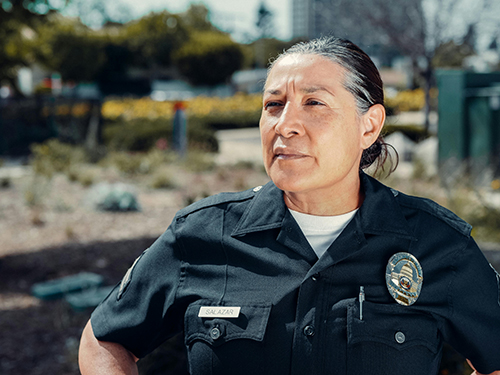 Law enforcement has historically been a male-dominated profession. Prior research has shown that male and female officers have different behaviors when it comes to things such as use of force, addressing public drug use, addiction and homelessness, according to Zach Salazar, a public health researcher who worked with SHIELD, an occupational health and safety training program for police officers, to shape police training.
Salazar and his research team found the nature of policework is changing, particularly when it comes to combating addiction and homelessness.
“Our team believes that there’s a fundamental shift occurring around the role of law enforcement and policing, and there’s a collision occurring at the intersection of public health and public safety. Law enforcement officers are increasingly being asked to serve public health functions with little to no public health training,” he said.
However, this more public health-based approach to law enforcement can create a disconnection between what newly recruited officers think they are going to do and the reality on the job.
“They say they didn’t sign up for what they’re doing and that they didn’t know that they were getting into this,” Salazar said. “They didn’t want to be a social worker, and now they are a social worker.”
Compared to their male counterparts, female law enforcement officers are less likely to report that they have ever fired their weapon in the line of duty, less likely to use force and less likely to conduct unnecessary searches.
However, according to Salazar, women in law enforcement are more likely to have stress or burnout from their jobs than men are.
The attitudes of female law enforcement officers can lead to “compassion fatigue,” said Tanya Zaglauer Schmell, of Crisis Systems Management LLC.
Schmell, a retired sergeant with more than 20 years’ experience, said the need to get law enforcement officers out of stress, fatigue and burnout led her to her current role leading a peer support network for law enforcement officers that provides resiliency training. Schmell and her colleagues focus on psychological, emotional, physical and social wellness.
The issues that can lead to stress or burnout differ between male and female officers, Schmell said. Male officers tend to be more stressed from interactions in the court system, while the majority of female officers’ frustration coming from inside their law enforcement agency.
Women in law enforcement face higher levels of harassment, bias, underestimation of their physical capabilities, and a lack of support from their supervisors. They can feel a lack of camaraderie in a career field that is still composed primarily of men. When she retired in 2016, Schmell ended her time as the first female sergeant in her local police force — and no other woman has held the role since.
Schmell said it’s important to identify and recognize stressors so they can help each other.
“We help them on the street, but we don’t necessarily help them in our own house,” she said.
Photo by Kindel Media, courtesy Pexels.