






Public Health Newswire from The Nation’s Health brings you the news you need now


Public Health Newswire
Op-ed: Local organizations using partnerships to protect health, environment
- Mary Stortstrom
Simple but targeted actions can make a big difference in protecting people from environmental health harms.
That was one of the lessons learned recently by a coalition of health advocates in Northern Thailand who have been working for years to halt a coal mining project.
While the Thai government had designated the land for mining use, and the mining company conducted an environmental impact assessment for the project, the local Omkoi community, who are most at risk of health and social harm from the project, had been left out of the process. Using the power of storytelling, the Omkoi community spoke to officials about how the coal mine would harm their drinking water and surrounding forests.
On Feb. 13, Thailand’s Supreme Administrative Court halted the mining project.
The example was one of many shared in March at the “Our Planet, Our Health” conference in Arlington, Va., which was organized by the Medical Society Consortium on Climate and Health and supported by APHA.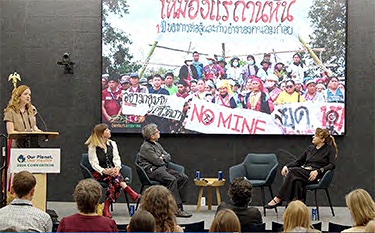
Coalitions such as the one that took shape in Northern Thailand can serve as the cornerstone for action on environmental health issues. One such partnership is the Alliance of Nurses for Healthy Environments, which supports nurses in promoting environmental health, while also helping bring together nurses of color.
Though it had originally formed in 2016, the program had become dormant. In 2024, Milagros Elia, MA, the alliance program manager, joined with colleagues to revive it, emphasizing the role of minority nursing organizations.
As nurses hold trusted positions in their communities, it is essential to include them in strategies to reduce climate-related health threats where people are the most impacted, Elia said.
“I didn't see a lot of minority nursing organizations in the original collaborative,” Elia said. “If you’re not at the table, you’re on the menu, and we had to be at the table.”
In 2024, the group was among 25 other nursing organizations that met with the White House Council on Environmental Quality to discuss extreme heat impacts on human health.
Partnerships have also played a critical role in helping provide access to care and protections to U.S. immigrants across the nation who are facing violence and other challenges following actions by the Trump administration.
Jo Bjorgaard, DNP, RN, senior climate and health manager at the Climate Advocacy Lab, pointed out that many communities in states have resisted ICE immigration actions. And numerous advocacy groups have worked to bring public health to immigrants.
“We've seen rapid-response networks form truly overnight,” Bjorgaard said. “There were faith communities coordinating sanctuary, health care workers organizing to protect patients and their access to care, and neighbors providing mutual aid to ensure that families have their basic needs met.”
Caption: Climate health advocates gave presentations at “Our Planet, Our Health” a conference in Arlington, Va., in March. Screenshot courtesy The Nation's Health