






Public Health Newswire from The Nation’s Health brings you the news you need now


2025 Annual Meeting
As the U.S. crackdown on immigrants escalates, public health responds
- Mark Barna
The Trump administration has built an immigrant enforcement machine on a scale never seen before in America. ICE agents are reaching into workspaces, communities and even the health care system to enforce harmful immigration policies, upending people’s lives.
Sarah Kimball, director of the Immigrant and Refugee Health Center at Boston Medical Center, has treated patients whose lives and health have been turned upside down by U.S. immigration practices.
“This a dark and frightening time for immigrant people (in America),” Kimball said Tuesday at APHA 2025’s session “Horrific Attacks on Immigrants and Refugees: Protecting Our Communities and Fighting Back.”
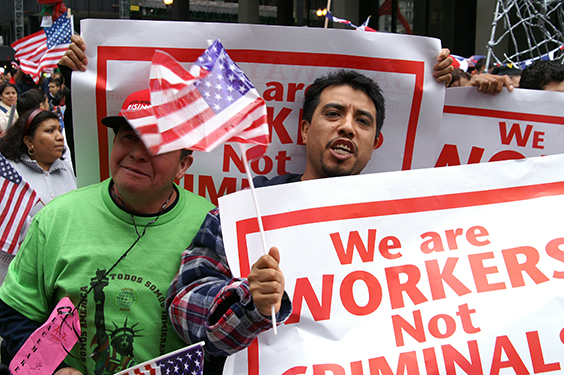 Federal and state immigrant policies have changed the landscape of health access, trust and care for immigrants and refugees, said Kimball, who calls for health care providers treating immigrants to advocate for their patients’ health rights.
Kimball offered best practices for immigrant health care services. While ICE agents can enter public spaces, agents without a warrant are legally not allowed to conduct their business in private spaces, which includes health care waiting rooms, she said. The Boston Medical Center’s immigrant health waiting room prominently displays a sign saying, “Our waiting room is a private patient care area. Only patients and those accompanying patients are permitted to enter.”
Though the sign may seem an innocuous gesture, it can be effective because it openly and plainly designates the area as safe space and can cause ICE agents to at least think twice before performing any action, Kimball said.
Confidentiality of medical records are protected in U.S. law, but immigration officials can sometimes obtain the records through legal processes. To make their work a little harder, Kimball recommends that clinical staff avoid using words and phrases such as “undocumented,” “Illegal” and “without papers” in reports on immigrant patients. This can mitigate risk of immigration status-related disclosure.
By law, health care clinics cannot share personal medical information with other entities, including immigration officials. Immigrants on Medicaid rolls or receiving other government-funded benefits need to know this, Kimball said.
Though in July the U.S. Centers for Medicare and Medicaid Services shared Medicaid recipient data with the Department of Homeland Security for immigration enforcement purposes, a federal judge in August issued a preliminary injunction blocking the sharing of Medicaid data with immigration authorities in the 20 states that joined the lawsuit.
No additional risk arises for immigrants by continuing to be on government-funded health programs because DHS already has the household’s address from the original sign-up, Kimball said. Dropping off Medicaid and other government-funded services won’t erase the data immigrants have already provided, and keeping the benefits helps ensure health and well-being.
Conversations like this can build trust between care professional and patient, Kimball said, showing that the professional supports immigrants’ legal right to health care.
“We have to proactively fight if we want any trust with immigrant refugees,” Kimball said.
Tucson center opened to support migrants
Immigrants face multiple challenges in the U.S., even without ICE agents outside their door. Through a multi-year grant from the Centers for Disease Control and Prevention, the Southeast Arizona Health Education Center in Tucson opened a center to support migrants. The Community Health Advocates for Migrant Population Services, which operated 2022–2025, served migrants who had requested asylum and needed to decompress before continuing their journey in the states, said Taylor Leigh, a community health worker at Southeast Arizona Health Education Center.
The program offered health care education and services, especially important because some migrants have their medicines for chronic ailments confiscated at the U.S.-Mexico border. Migrants are also referred to food banks, Head Start programs, adult English classes and other services.
The program bridged a public health gap for people with limited funds and work skills and no health coverage newly arriving in the country, Leigh said. The work was successful because it treated migrants with dignity.
“Care becomes possible only when relationships are built on empathy, consistency and respect,” she said.
Unfortunately, the current administration has rescinded CDC’s grant for the program. After four years, the Community Health Advocates for Migrant Population Services is no more.
Photo by AMenTwolejandrophotography, courtesy iStockphoto.