


Public Health Under Threat
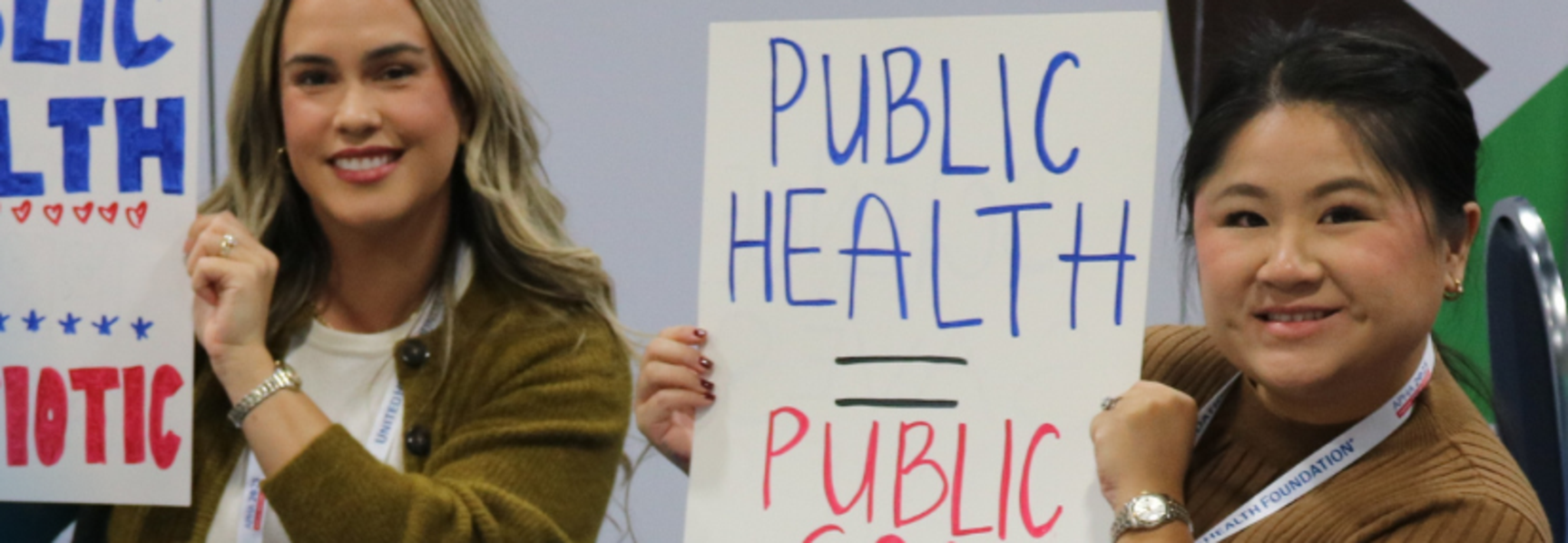

Join us in protecting science-based vaccine access!
More sick children. More hospitalizations. More preventable deaths. The Administration, through RFK, Jr., unilaterally and with no evidence made changes to the vaccine guidelines. The public health impact is clear, and we knew it could not go unchallenged. When vaccine guidance is weakened without clear scientific support, people feel it.
This is the moment to protect science-based vaccine guidance and access to care. Donate today and join the public health community as we continue this suit and related efforts to defend the science that keeps our children safe.
Legal Actions APHA Has Been Part Of:
Coalition Sues Trump EPA for Failure to Implement Life-Saving National Soot Standard
APHA and several organizations sue EPA over illegal repeal of climate protections
APHA Joins Others to Sue HHS, Robert F. Kennedy, Jr. for Unlawful, Unilateral Vaccine Changes
Researchers Challenge NIH's Politically Driven Grant Cancellations
The Latest on How APHA Is Protecting Public Health (October 2026)
APHA joins lawsuit against EPA repeal of power plant pollution rule
On Sept. 17, APHA and other leading public health and environmental organizations filed a lawsuit to stop the U.S. Environmental Protection Agency’s repeal of critical standards for power plant carbon pollution. APHA was joined by the American Lung Association, Natural Resources Defense Council, Clean Air Council, Clean Wisconsin (represented by Clean Air Task Force), and the Environmental Defense Fund. The groups filed the action at the U.S. Court of Appeals for the D.C. Circuit.
“Clean air is a basic human right. Power plant pollution threatens the health of millions of Americans and fuels climate change, worsening extreme heat, poor air quality and other serious health risks,” said Georges C. Benjamin, MD, CEO of the American Public Health Association in a press release announcing the lawsuit. “Weakening these life-saving standards would strip away vital protections for all, and especially for children, pregnant people and communities already overburdened by pollution. EPA must maintain strong clean air and climate standards so every community can live a healthy life.”
The 2024 standards repealed by the EPA on Sept. 17 were estimated to deliver a net savings of $370 billion in climate and health benefits, with benefits a stunning 20 times that of the costs to industry. A recent NRDC analysis found that this administration’s policies will destroy $700 billion in new power sector investments over the next decade and cut by half the power sector carbon reductions likely before its policies took effect.
According to EPA in 2024, in 2035 alone, the regulatory impact analysis included with the rule estimated substantial health co-benefits including:
- Up to 1,200 avoided premature deaths
- 870 avoided hospital and emergency room visits
- 1,900 avoided cases of asthma onset
- 360,000 avoided cases of asthma symptoms
- 48,000 avoided school absence days
- 57,000 lost workdays
APHA joins public health comments to HHS on vaccine RFI
On Sept. 18, APHA joined the Robert Wood Johnson Foundation, the Liberty Health Alliance, the Geiger Gibson Program in Community Health, the Jacobs Institute of Women’s Health, and 14 distinguished health law and policy scholars in submitting comments to a request for information from the U.S. Department of Health and Human Services regarding categories used in federal vaccine recommendations and, in particular, the proper role of shared clinical decisionmaking in medicine, including with respect to decisions about vaccinations.
The Advisory Committee on Immunization Practices developed the current effective, science-based system for determining the appropriate recommendation categories for vaccines that was in effect in January 2025. That system relied on GRADE (Grading of Recommendations, Assessment, Development and Evaluation) — an internationally adopted framework for assessing the strength of recommendations in healthcare and the certainty of the evidence behind them — and the Evidence-to- Recommendations framework process by which ACIP evaluated the range of factors that were the basis of its recommendations.
In their comments, APHA, along with partner organizations and experts, note that changing the framework and adopting new categories of recommendations that would serve as the basis of future vaccine recommendations, as the RFI suggests, would bypass both the transparency and the deliberative process of ACIP required by the Federal Advisory Committee Act. It also would violate substantive law, because Congress’ express designation of ACIP as the body responsible for vaccine recommendations, in multiple statutes, restricts the Department’s authority to alter ACIP’s procedural and substantive standards.
Public health organizations and scholars file amicus brief challenging CMS Medicaid work requirement rule
On Sept. 10, APHA, Grantmakers in Health, the George Washington University Milken Institute School of Public Health’s Jacobs Institute of Women’s Health and National Center for Medical-Legal Partnership, Liberty Health Alliance and 161 public health and health policy deans, chairs and scholars filed an amicus curiae brief supporting a challenge to a federal Medicaid rule they argue unlawfully narrows protections for people with serious health conditions.
The brief supports the 26 states challenging the Centers for Medicare and Medicaid Services’ interim final rule implementing Medicaid community engagement requirements in the lawsuit Massachusetts v. Oz.
Under legislation enacted by Congress in 2025, certain Medicaid enrollees must complete at least 80 hours per month of work, community service or education to enroll or maintain eligibility. Congress created an exclusion for people who are medically frail or have special medical needs, including people with serious or complex medical conditions, certain disabilities, substance use disorders and disabling mental health conditions.
The amici argue that CMS went beyond Congress’ intent by requiring people with qualifying health conditions to also prove that their condition significantly impairs their ability to meet the 80-hour requirement. The rule also limits the evidence states can use to determine whether someone qualifies for the medical frailty exclusion.
Senate Agriculture Committee passes Farm Bill
On Sept. 16, the Senate Agriculture Committee voted to pass S.5526, the Agricultural Act of 2026, by a partisan vote of 12-11. The Committee was previously unable to pass the legislation during a vote in August due to disagreement over the $180 billion in cuts to the Supplemental Nutrition Assistance Program made last year, with Democrats advocating for a two-year delay to the cuts. The September vote managed to pass the bill with the return of Senator Mitch McConnell (R-KY).
If enacted into law, the failure to undo the SNAP cuts would result in costs being shifted to states and counties and many people who depend on SNAP losing access to the nutrition program. APHA previously joined a letter to Congress urging opposition to the House draft of the Farm Bill, which similarly fails to fix the SNAP cuts and contains provisions harmful to the environment. The House passed that bill in April.
APHA advocates can reach out to their Senators and urge them to oppose this version of the Farm Bill when it comes to the Senate floor for a vote.
Attend public health advocacy sessions at the 2026 Annual Meeting!
Will you be joining us in San Antonio for the 2026 Annual Meeting & Expo or attending virtually? As you’re building your schedule, make sure to check out some of our advocacy sessions to learn more about opportunities to boost the public health voice!
Advocacy for Leaders | Sunday, Nov. 1 | 2-5 p.m. CT
This session will provide an overview of effective public health advocacy strategies, trends in public health advocacy and examples of successful advocacy programs.
Advocacy in the Current Political Climate | Monday, Nov. 2 | 10:30 a.m.-2 p.m. CT
This session will give an overview of the difference between advocacy and lobbying and break down how public health workers can get involved in advocacy in a way that conforms to the rules of their job.
Mobilizing a Public Health Campaign | Monday, Nov. 2 | 2:30-4 p.m. CT
This session, led by APHA’s Action Board, will highlight speakers from state and local public health campaigns, allowing them to discuss how they effectively engaged in advocacy to manifest change.



Toolkit: Crisis Communications for Public Health
APHA's Role in Defending Public Health
APHA is fighting back. We remain steadfast in our efforts to challenge harmful policies, advocate for evidence-based approaches and defend the well-being of all Americans.




APHA on key public health policy issues
Hear what APHA has to say about policy proposals that will impact public health.

American Public Health Association and Epstein Becker Green to Launch a Comprehensive 50-State Assessment of U.S. Immunization Laws and Policies
The American Public Health Association (APHA) and Epstein Becker Green announced the upcoming launch of The Legal Epidemiology of U.S. Immunization Law, a comprehensive project to assess and document state-level immunization law across the United States.
EPA Sued Over Repeal of Power Plant Carbon Reduction Rules
Environmental and public health groups sued to stop the Environmental Protection Agency’s repeal of critical standards for power plant carbon pollution.
New report shows that cuts to SNAP and WIC are fueling a hunger and public health crisis
Federal cuts to food assistance programs are inflicting real hardships for American families. Millions are losing access to SNAP and WIC as grocery prices continue to climb. Today, the Campaign for the Public's Health, an American Public Health Association initiative, released a new report in partnership with Protect Our Care.
New Control of Communicable Diseases Manual includes info on a potentially first climate-driven disease
“In an era of increasing numbers of infectious disease outbreaks, it’s important to have a reliable, fact-based source, to consult. CCDM is that go-to, essential resource for epidemiologists and other public health practitioners, clinicians and laboratorians working to keep communities safe and informed,” says Dr. Troisi.
Other Resources:
The Union of Concerned Scientists (UCS) is tracking attacks on science at the federal level. View the tracker and methodology.
How you can help

Donate to APHA
Make an impact on public health through your donation.
Contact your members of Congress
Urge congress to support public health.
Fight for science-based policies
Stand up for public health interests by donating to help APHA Speak for Health.