




Public Health Newswire from The Nation’s Health brings you the news you need now


Public Health Newswire
Representation, intersectional approach can boost health equity for people with disabilities
- Mary Stortstrom
Disability as a public health topic is often only viewed through an accessibility lens. However, people with disabilities are frequently left out of conversations about them, rather than others in public health talking to them and getting input from their lived experience.
This was the topic of discussion at the “Conversation Starter: How Can Public Health Better Advance Equity for People with Disabilities?” networking session at APHA 2026 on Sunday. A collaborative session hosted by the APHA Committee of Health Equity and endorsed by the Family Violence Prevention Caucus, the informal discussion was a space for sharing ideas and experiences.
Cerise Hunt, with the Colorado School of Public Health at the University of Colorado, brought up the importance of including the voices of people from the disability community in the broader public health conversation, saying that is the first step toward improving health equity for people with disabilities.
“I think we come in these collective spaces, and we have the strategies, we know what to do, but we’re not enacting them on an individual level,” Hunt said.
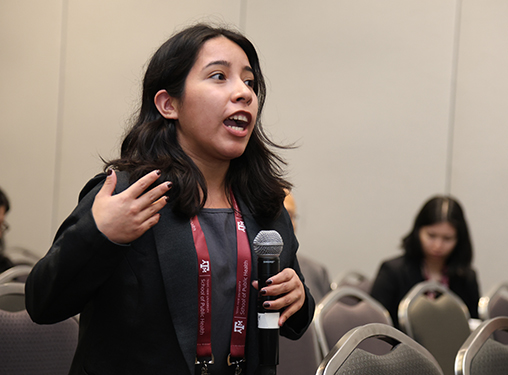 Kimberly Ortiz, who works at Trinity Washington University in Washington, DC, has a disability and identifies as Latina. She mentioned there are many social and cultural factors that affect people with disabilities that are often not taken into account.
“I’m part of all these minority groups, so I don’t just bring the perspective of disability; I’m not looking to help just the disability community,” Ortiz said. “I’m looking to help every community that I fit into.”
Representation of people with disabilities is important, especially when it comes to policymaking, said Deborah Smith, an assistant professor at Louisiana State University Health Sciences Shreveport and chair of APHA’s Committee on Health Equity. Smith moderated Sunday’s discussion.
“Now that we’re in the election (season), have you seen any people living with disabilities running?,” Smith asked. “But, if you really want to be heard, you have go beyond this wall, beyond the (American Public Health) Association, beyond your job, and go actually be with the community and with the policymakers.”
Smith also talked about how intersectionality plays a role in advancing health equity. Smith, who is Latina, said she is also concerned about immigration and language barriers in addition to health equity. All of that influences public health policy advocacy.
Because there is a lack of representation by people with disabilities in top positions in government or institutions, Smith encouraged everyone participating in the conversation to advocate for themselves.
“Only you know what you’re going through,” she said.
Photo: Kimberly Ortiz. Photo courtesy EZ Event Photography.