




Public Health Newswire from The Nation’s Health brings you the news you need now


Public Health Newswire
Experts discuss pros, cons of psychedelics for recreational, clinical purposes
- Mark Barna
A growing body of research suggests that psychedelic drugs offer therapeutic benefits for some people with debilitating conditions. At a Monday lightning session, “Psychedelics and Public Health,” researchers offered quick takes on the pros and cons of using the mind-altering substances to treat patients.
In 2025, 11 million Americans microdosed psilocybin, the most popular psychedelic, according to the RAND Psychedelics Survey. Advocates contend that psychedelics open the mind to enhance people’s lives. While negative experiences are not uncommon and can include frightening hallucinations, “bad trips” can be mitigated by dosing in supportive and supervised settings.
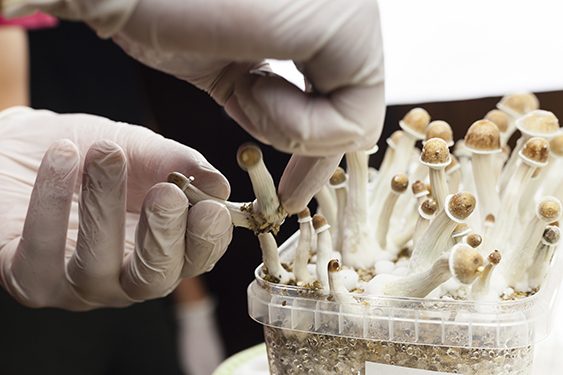 Some studies show promise that the drugs can ease patients’ treatment-resistant anxiety, post-traumatic stress disorder, or depression, as well hospice patients’ negative psycho-physical experiences.
This year, the U.S. Food and Drug Administration finalized its guidance on how researchers should study psychedelics and held a public hearing on protocols involving screening, monitoring, delivery and training. The FDA is expected to decide in 2027 if psilocybin will be administered for treatment-resistant depression in clinical settings.
Some psilocybin advocates would like to see the substance administered to veterans experiencing treatment-resistant PTSD or other mental health conditions. Suicide is the second leading cause of death among veterans under age 45, according to the 2025 National Veteran Suicide Prevention Annual Report.
Results of a qualitative study are being tallied from feedback from 15 veterans who took part in a mountain retreat where psilocybin was administered under controlled conditions. Many of the participants suffer from serious mental health issues.
Several have already given feedback to researchers at Boston University Sargent College of Health and Rehabilitation Sciences and the Truxtun Foundation. Veterans reported improved mood, outlook and connection with others, researcher Kelly Pesanelli said on Monday.
“Many veterans disengage from conventional care,” Pesanelli said. “Psychedelics combined with ongoing therapy could improve engagement.”
But Kevin Yang, a health psychiatrist at the University of California, Los Angeles, points out that clinical trials involving psychedelics often exclude individuals with complex mental health problems, which skews findings. He also said that, while hallucinogens can be safe when used in controlled settings, recreational use — which is skyrocketing in the U.S. — may pose additional risks.
Yang was lead author of a recent study that examined data from the 2022-2025 Healthy Minds Study. Researchers looked at psilocybin use of over 200,000 graduate and undergraduate college students at more than 200 higher learning institutions.
Besides experimenting with psilocybin, many respondents said they also use tobacco products, engage in binge drinking and smoke cannabis, all potentially health-harming practices. Some also experience thoughts of suicide and psychotic disorders, which would disqualify them from participation in most psychedelic clinical trials.
Psychedelics may be another way to mask the pain rather than treat it, some contend.
“Associations may reflect self-medication, adverse effects or shared underlying risk factors,” Yang said.
Photo by Moha El-Jaw, courtesy iStockphoto.